
Pakistan Federal Budget 2026-27: A Complete Breakdown of Numbers, Priorities, and What It Means for the Economy

Table of Contents
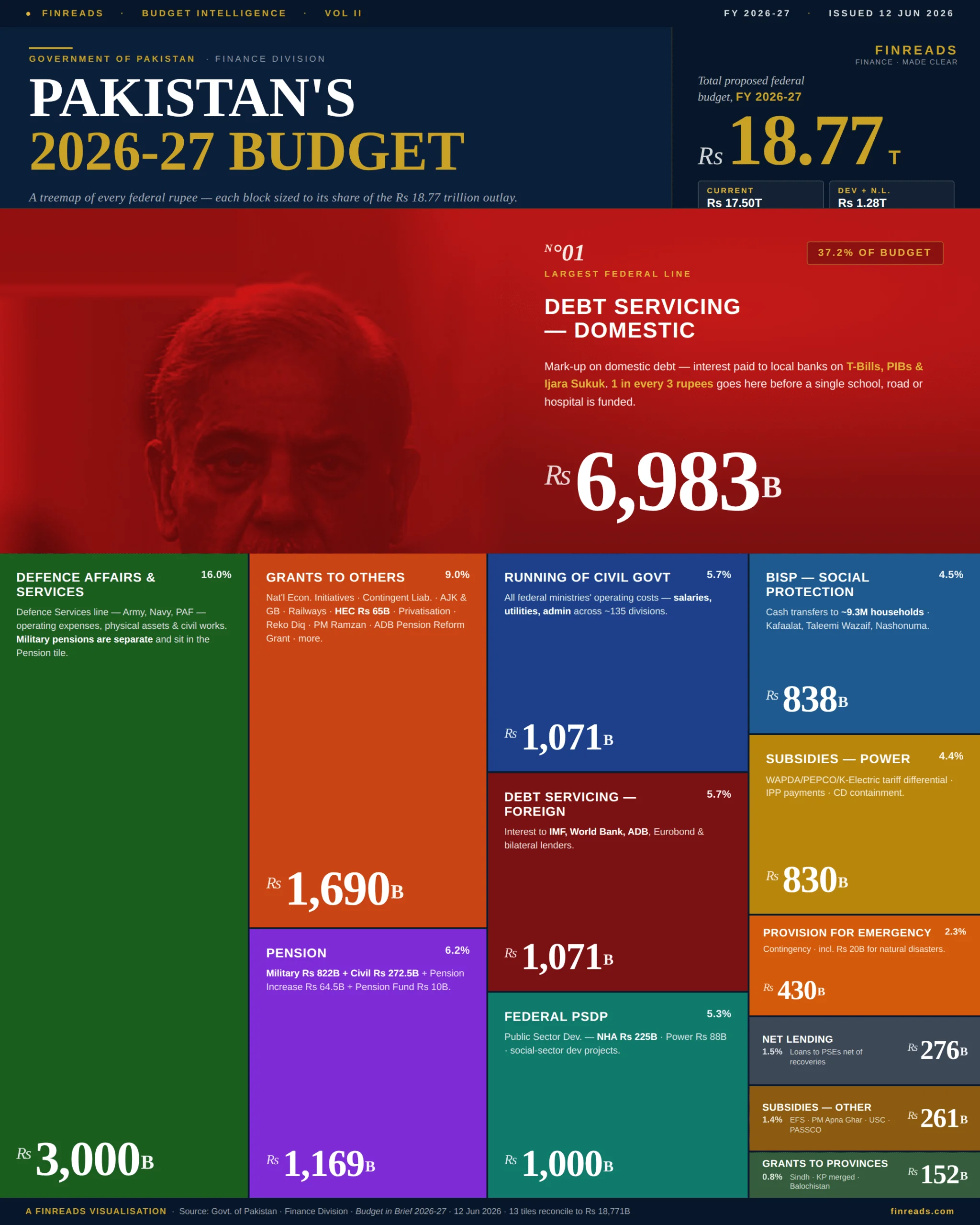
Total outlay Rs 18,771 billion. Federal fiscal deficit of Rs 7,020 billion, with the overall deficit targeted at 3.6% of GDP. A bigger tax target, faster revenue growth, and a budget that leans on revenue rather than spending cuts to hold the line. Here is everything the Federal Budget 2026-27 actually contains — explained in plain English, compared with last year, and benchmarked against how advanced economies allocate their money.
Introduction: The Budget at a Glance
On 12 June 2026, the Finance Division presented the Federal Budget for fiscal year 2026-27 to Parliament. On paper, the headline number is Rs 18,771 billion in total resources, matched exactly by Rs 18,771 billion in total expenditure. That is roughly 13% of nominal GDP, against an economy now projected at Rs 143.6 trillion.
But the real story is not in the headline. It is in the composition: how much is consumed by interest payments, how little is left for development, where new revenue is supposed to come from, and how the government plans to finance a federal deficit of Rs 7,020 billion.
This blog walks through all of it — revenue, expenditure, the PSDP, subsidies, the new green budget tags, and the fiscal arithmetic — compares it line-by-line with FY2025-26, lays out the pros and cons honestly, and ends with a comparison against how advanced economies (US, UK, Germany, Japan) structure their own budgets.
Budget 2026-27: Headline Numbers You Need to Remember
Before the deep dive, lock in the numbers that anchor the whole budget. Note the comparison below is against the FY2025-26 Revised Estimates (RE) — the actual revised outturn — not the original budget targets:
| Metric | FY2026-27 (BE) | FY2025-26 (Revised) | Change |
|---|---|---|---|
| Total Outlay | Rs 18,771 bn | Rs 15,642 bn | +20.0% |
| FBR Tax Revenue | Rs 15,264 bn | Rs 12,983 bn | +17.6% |
| Non-Tax Revenue | Rs 5,336 bn | Rs 5,093 bn | +4.8% |
| Provincial Share (NFC) | Rs 8,848 bn | Rs 7,592 bn | +16.5% |
| Net Federal Revenue | Rs 11,751 bn | Rs 10,485 bn | +12.1% |
| Federal Fiscal Deficit | Rs 7,020 bn | Rs 5,157 bn | Wider in rupees |
| Overall Deficit (% GDP) | 3.6% | 3.0% | Higher vs revised |
| Primary Surplus | Rs 2,828 bn (2.0%) | Rs 3,159 bn (2.5%) | Lower |
The takeaway: revenue is growing fast, expenditure is also rising, and the deficit-to-GDP ratio is set at 3.6% — below the original FY2025-26 budget target of 3.9%, but above the unusually low 3.0% the government actually landed in the revised estimates. The primary surplus, the IMF’s favourite metric, has shrunk. This is a revenue-led budget, not an austerity one.
Where the Money Comes From: Revenue Side Explained
FBR Tax Revenue: The Rs 15,264 Billion Engine
The Federal Board of Revenue is being asked to deliver Rs 15,264 billion — an 8% increase over the original FY2025-26 target and a much steeper 17.6% increase over what FBR actually collected in the revised estimates (Rs 12,983 billion).
The split between direct and indirect taxes is almost exactly 50-50:
Direct Taxes — Rs 7,613 billion (49.9%)
- Income Tax: Rs 7,481 bn — the single largest tax line in the entire budget
- Workers Profit Participation Fund (WPPF): Rs 83.6 bn
- Capital Value Tax (CVT): Rs 26.6 bn
- Workers Welfare Fund (WWF): Rs 22.3 bn
Indirect Taxes — Rs 7,651 billion (50.1%)
- Sales Tax: Rs 4,927 bn — the workhorse of indirect taxation
- Customs Duties: Rs 1,651 bn
- Federal Excise: Rs 1,073 bn
Pakistan still leans heavily on indirect taxes, which are regressive (they hit lower-income households disproportionately). For context, in advanced economies indirect taxes typically contribute 30-40% of total tax revenue, not 50%.
Non-Tax Revenue: Rs 5,336 Billion
Non-tax revenue is the second pillar, and it has become structurally important over the last three years. The big lines:
- Petroleum Levy: Rs 1,677 bn — the largest single non-tax line
- SBP Profit: Rs 1,436 bn
- Grants/Receipts from Provinces (Article-164): Rs 1,035 bn — a major new provincial resource transfer, not a tax
- Mark-up (PSEs & Others): Rs 171 bn
- Dividends: Rs 130 bn
- Mark-up (Provinces): Rs 101 bn
- Natural Gas Development Surcharge: Rs 71 bn
- Climate Support Levy (new): Rs 50 bn
- PTA (4G/5G Licences): Rs 28 bn
- Off-the-Grid (Captive Power Plants) Levy (new): Rs 15.7 bn
A word of caution on a number that is widely misread: the Rs 1,035 billion line is a provincial resource transfer under Article-164, not a new captive-power tax. The actual Off-the-Grid Captive Power Plants Levy is a far smaller Rs 15.7 billion. The captive levy is best understood as a forcing mechanism to nudge industrial captive users onto the national grid — a policy signal, not a revenue engine.
Provincial Share Under the NFC Award
Out of FBR’s collection plus straight transfers, Rs 8,848 billion (about 57.5%) flows directly to the provinces under the 7th NFC Award. Province-wise:
- Punjab: Rs 4,403 bn (49.8%)
- Sindh: Rs 2,207 bn (24.9%)
- Khyber Pakhtunkhwa: Rs 1,443 bn (16.3%) — includes 1% for war on terror
- Balochistan: Rs 795 bn (9.0%)
After provincial transfers, the federal government keeps just Rs 11,751 bn in net revenue — and it must finance Rs 18,771 bn in expenditure from this. That gap is the federal fiscal deficit.
Where the Money Goes: Expenditure Side Explained
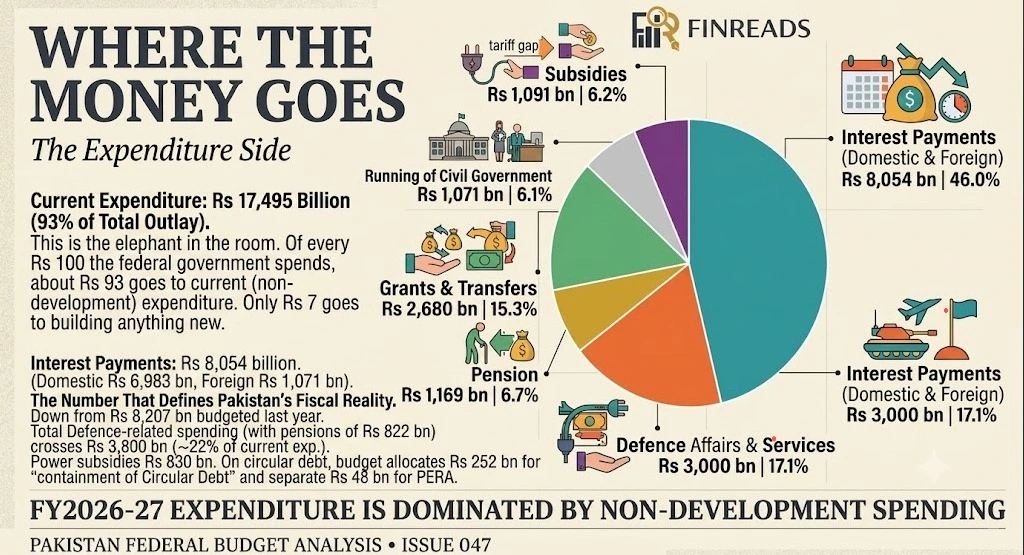
Current Expenditure: Rs 17,495 Billion (93% of Total Outlay)
This is the elephant in the room. Of every Rs 100 the federal government spends, about Rs 93 goes to current (non-development) expenditure. Only Rs 7 goes to building anything new.
The Big Six current expenditure heads (YoY vs original FY26 budget):
| Head | FY2026-27 | % of Current Exp. | YoY Change |
|---|---|---|---|
| Interest Payments | Rs 8,054 bn | 46.0% | -1.9% |
| Defence Affairs & Services | Rs 3,000 bn | 17.1% | +17.6% |
| Grants & Transfers | Rs 2,680 bn | 15.3% | +39.0% |
| Pension | Rs 1,169 bn | 6.7% | +10.8% |
| Running of Civil Government | Rs 1,071 bn | 6.1% | +10.3% |
| Subsidies | Rs 1,091 bn | 6.2% | -8.0% |
Interest Payments: The Number That Defines Pakistan’s Fiscal Reality
Rs 8,054 billion in interest — more than 46% of current expenditure, larger than defence and the federal PSDP combined, and equal to roughly 69% of net federal revenue. Of this:
- Domestic debt servicing: Rs 6,983 bn
- Foreign debt servicing: Rs 1,071 bn
The interest bill is down slightly from Rs 8,207 bn budgeted last year, reflecting the SBP’s policy-rate cuts and an improving debt profile. But it remains the single biggest constraint on every other policy choice.
Defence: Rs 3,000 Billion Plus Pensions
Headline defence is Rs 3,000 bn. But once you add military pensions of Rs 822 bn from the pension head, total defence-related spending crosses Rs 3,800 bn — about 22% of current expenditure.
Subsidies: Rs 1,091 Billion
Down from Rs 1,186 bn last year. The composition:
- Power-sector subsidies: Rs 830 bn (tariff differential, K-Electric, AJK, FATA-merged districts)
- Other subsidies: Rs 205 bn (housing schemes, SME credit schemes, miscellaneous)
- Industry & Production: Rs 37 bn (mostly EV scheme and urea fertilizer)
- Food (PASSCO): Rs 19 bn
On circular debt, the budget allocates Rs 252 bn for the “containment of Circular Debt”, a securitised mechanism to clear arrears, while the Pakistan Energy Revolving Fund (PERA) receives a separate Rs 48 bn. These are two distinct lines, often conflated.
Federal PSDP: The Development Squeeze
Federal PSDP for FY2026-27 is Rs 1,000 billion — flat versus last year. Total National PSDP (Federal + Provincial + SOEs + Corporations) is Rs 3,675 bn, down sharply from Rs 4,224 bn last year. Major federal allocations (FY2025-26 → FY2026-27):
- National Highway Authority: Rs 227 bn → Rs 225 bn
- Water Resources Division: Rs 133 bn → Rs 103 bn (cut, -22.7%)
- Provincial Projects: Rs 106 bn → Rs 88 bn (cut, -16.6%)
- Power Division (NTDC/PEPCO): Rs 90 bn → Rs 88 bn
- Special Areas (AJK & GB): Rs 82 bn → Rs 89 bn (increase, +8.6%)
- Merged Districts of KP: Rs 65 bn → Rs 56 bn (cut, -14.3%)
- CPEC 2.0 New Initiatives: Rs 1 bn (new line)
The squeeze on water resources and the ex-FATA merged districts is hard to miss. With climate change driving more frequent water crises, the cut to the Water Resources Division is a particularly debatable choice. Special Areas (AJK & GB) is the notable exception, receiving a modest increase.
Fiscal Deficit and Financing: How Pakistan Closes the Gap
The federal deficit is Rs 7,020 bn — financed three ways:
- Net Domestic Financing — Rs 6,046 bn (86%)
- Government Securities (T-Bills, PIBs, Sukuk): Rs 5,772 bn
- NSS, GP Fund, Deposits & Reserves: Rs 274 bn
- Net External Financing — Rs 813 bn (12%)
- Multilateral & Bilateral sources: Rs 30 bn
- Commercial loans & Bonds: Rs 783 bn
- Privatisation Proceeds — Rs 161 bn (2%)
Pakistan continues to lean overwhelmingly on domestic banks to finance the deficit — healthy from a balance-of-payments perspective but it crowds out private credit and keeps real interest rates high.
The provincial surplus is assumed at Rs 1,794 bn, which when netted brings the overall consolidated fiscal deficit to 3.6% of GDP — meeting the IMF programme target.
Budget 2026-27 vs Budget 2025-26: A Direct Comparison

Here is the cleanest year-on-year comparison, with both the original FY2025-26 budget (BE) and the revised outturn (RE):
| Line Item (Rs bn) | BE 2025-26 | RE 2025-26 | BE 2026-27 | YoY (BE-BE) |
|---|---|---|---|---|
| FBR Revenue | 14,131 | 12,983 | 15,264 | +8.0% |
| Non-Tax Revenue | 5,147 | 5,093 | 5,336 | +3.7% |
| Gross Revenue | 19,278 | 18,076 | 20,600 | +6.9% |
| Provincial Transfers | 8,206 | 7,592 | 8,848 | +7.8% |
| Net Federal Revenue | 11,072 | 10,485 | 11,751 | +6.1% |
| Total Expenditure | 17,573 | 15,642 | 18,771 | +6.8% |
| Federal Budget Deficit | 6,501 | 5,157 | 7,020 | +8.0% |
| Overall Deficit (% GDP) | 3.9% | 3.0% | 3.6% | — |
| Primary Surplus | 3,170 | 3,159 | 2,828 | -10.8% |
| Nominal GDP | 129,567 | 126,870 | 143,604 | +10.8% |
What jumps out:
- FBR is being asked to do more than the original FY26 budget (+8%) and far more than it actually collected (+17.6% over revised).
- Total expenditure is rising, not falling. Outlay grows +6.8% BE-to-BE and +20% over the revised estimate. This is not an expenditure-cut budget.
- The deficit-to-GDP target of 3.6% is below the original FY26 budget (3.9%) but higher than the FY26 revised outturn (3.0%) — so consolidation is measured against the budget, not the actual result.
- The primary surplus is shrinking (Rs 3,170 bn → Rs 2,828 bn), which the IMF will scrutinise carefully in upcoming reviews.
Gender, Climate, and Disaster Tagging: A New Era of Budget Transparency
For the first time at this scale, the budget includes explicit tagging of allocations for gender, climate, and disaster (Table 18). The FY2026-27 numbers:
Gender-Tagged Allocations: Rs 2,123 bn
- Health & Well-being: Rs 870 bn
- Equality & Quality of Education: Rs 653 bn
- Government & Data Systems: Rs 514 bn
- Employment & Economic Opportunity: Rs 60 bn
- Safety & Security: Rs 21 bn
- Agency, Political Participation & Meaningful Engagement: Rs 4 bn
The scale of FY27 gender tagging (a sharp jump from prior years) reflects a much broader tagging methodology rather than new standalone schemes.
Climate-Tagged Allocations: Rs 214 bn (exclusive of subsidies)
- Mitigation: Rs 124 bn
- Adaptation: Rs 70 bn
- Supporting Areas: Rs 19 bn
Disaster-Tagged Allocations: Rs 116 bn
- Preparedness: Rs 43 bn
- Response: Rs 33 bn
- Recovery & Rehabilitation: Rs 21 bn
- Reconstruction: Rs 19 bn
The Green Component of Revenues (Table 20) totals roughly Rs 1.9 trillion — petroleum levy, GIDC, climate support levy, and oil/gas royalties. The Green Component of Subsidies (Table 19) is Rs 476 bn, dominated by Rs 423 bn in mitigation-classified energy subsidies. This tagging is genuinely useful for tracking how Pakistan responds to climate commitments — and how donors and lenders assess green-finance flows.
Pros of the Federal Budget 2026-27
1. Revenue-led deficit reduction
The deficit-to-GDP target of 3.6% sits below the original FY26 budget of 3.9%, and the heavy lifting is done by revenue growth rather than spending compression. A 17.6% jump in FBR collection over the revised estimate, if delivered, is the engine of consolidation.
2. Tax base broadening is finally moving
The Climate Support Levy, the EV Adoption Levy, and stepped-up direct-tax targets point toward a more diversified revenue base. Direct taxes are projected at 49.9% of FBR collection — a structural improvement over Pakistan’s historic indirect-tax dependence.
3. Subsidy rationalisation continues
Power-sector subsidies fall to Rs 830 bn (from Rs 1,036 bn budgeted last year). The shift toward targeted instruments — BISP, EV incentives, low-cost housing — is aligned with IMF benchmarks.
4. Green budgeting framework
Climate and disaster tagging gives Pakistan a credible framework to attract green finance, including from the IMF Resilience and Sustainability Facility and multilateral climate funds.
5. Lower interest-cost trajectory
Interest payments are budgeted Rs 153 bn lower than last year’s original estimate — a reflection of policy-rate easing and an improving debt-maturity profile.
6. Pension transparency
By consolidating civil and military pensions into a single Rs 1,169 bn line, the budget improves transparency on the true defence-related fiscal burden.
Cons of the Federal Budget 2026-27
1. The PSDP is being starved
A Rs 1,000 bn Federal PSDP against Rs 18,771 bn total outlay means just 5.3% of the budget is for development. Advanced economies typically allocate 15-25% to capital expenditure. Pakistan’s growth ceiling is structural.
2. Interest payments still eat the budget
At Rs 8,054 bn, debt servicing consumes close to 69% of net federal revenue. Until the debt stock falls relative to GDP, every other budget item is squeezed.
3. Revenue targets are ambitious
FBR is being asked to grow collection 17.6% over revised estimates. Historically, FBR has rarely delivered double-digit collection growth without external buoyancy (commodity prices, import surges).
4. Indirect taxes still dominate
A 50-50 direct/indirect split looks balanced, but indirect-tax incidence falls disproportionately on lower-income households. Pakistan’s effective tax progressivity remains weak.
5. The deficit is wider than the FY26 outturn
Measured against the unusually strong FY26 revised result (3.0% of GDP), the 3.6% target is actually a loosening. The “consolidation” narrative holds only against the original budget, not the realised outcome.
6. Heavy reliance on provincial transfers
The budget assumes Rs 1,035 bn in provincial resource transfers under Article-164 plus a Rs 1,794 bn provincial surplus. If provinces under-deliver, the consolidated deficit widens and federal-provincial friction follows.
7. Water and ex-FATA cuts are concerning
Reducing the Water Resources Division PSDP from Rs 133 bn to Rs 103 bn, and the Merged Districts of KP from Rs 65 bn to Rs 56 bn — in a country facing intensifying climate stress and fragile post-conflict regions — is hard to defend on development grounds.
How Pakistan’s Budget Compares With Advanced Economies

The structure of Pakistan’s budget looks very different from advanced economies. The figures below are approximate, illustrative shares drawn from standard international comparisons, not from the Budget in Brief.
Development vs Current Spending
| Country | Development | Current |
|---|---|---|
| Pakistan (FY27) | ~5% | ~95% |
| United States | ~15% | ~85% |
| Japan | ~13% | ~87% |
| Germany | ~12% | ~88% |
| United Kingdom | ~10% | ~90% |
Pakistan’s development share is roughly a third of the advanced-economy norm.
Interest Payments as % of Revenue
| Country | Interest / Revenue |
|---|---|
| Pakistan (FY27) | ~69% |
| Japan | ~22% (highest in OECD) |
| United States | ~14% |
| United Kingdom | ~9% |
| Germany | ~3% |
Even Japan — with the world’s highest debt-to-GDP ratio — spends a far smaller share of revenue on interest, because its borrowing costs are near zero. Pakistan pays double-digit nominal yields on most of its domestic debt.
Tax-to-GDP Ratio
| Country | Tax-to-GDP |
|---|---|
| Pakistan (FY27 target) | ~10.6% |
| Germany | ~38% |
| United Kingdom | ~33% |
| Japan | ~31% |
| United States | ~27% |
Pakistan’s tax-to-GDP gap is the single most important structural fiscal problem. Even modest convergence — say to 15% — would transform the budget.
Direct vs Indirect Tax Mix
| Country | Direct | Indirect |
|---|---|---|
| Pakistan (FY27) | ~50% | ~50% |
| United States | ~65% | ~35% |
| Japan | ~60% | ~40% |
| United Kingdom | ~55% | ~45% |
| Germany | ~55% | ~45% |
Pakistan is moving in the right direction but remains more indirect-tax-reliant than advanced economies.
Social Protection & Defence
Pakistan’s federal social-protection allocation is about Rs 857 bn (4.9% of total outlay); the OECD average is closer to 15-20% of government spending. On defence, Pakistan spends roughly 17% of current expenditure (excluding pensions), against ~13% in the US, ~5% in the UK and Japan, and ~3% in Germany — among the highest relative defence burdens for its income level.
What This Budget Means for Different Stakeholders
For Salaried Individuals
Income-tax projections are up roughly 10% — expect tightening on the salaried slab and increased withholding enforcement. Basic exemption thresholds are likely to stay unchanged in real terms, meaning bracket creep continues.
For Businesses and Industry
- Captive power: The Off-the-Grid Captive Power Plants Levy (Rs 15.7 bn) is modest in revenue terms but signals policy intent to push gas-fired captive users onto the grid.
- Customs duties up ~4%: input-cost pressure on import-dependent sectors.
- Export-finance transition: schemes replacing SBP refinancing facilities will partially offset the EFS phase-out.
- EV incentive (Rs 8 bn): continues, supporting the auto sector’s transition.
For Investors
- Bond market: Rs 5,772 bn in government-securities issuance keeps domestic yields elevated — attractive for fixed income.
- Privatisation: Rs 161 bn in proceeds suggests at least one major divestment is planned.
- IMF anchor: a maintained primary surplus supports the equity-market narrative around programme continuation.
For Provinces
Provincial transfers jump 16.5% in absolute terms — but the assumed Rs 1,794 bn provincial surplus, plus Rs 1,035 bn in Article-164 transfers to the federal pool, means provinces are expected to contribute heavily to consolidation. Expect federal-provincial tension on this.
For the Climate-Vulnerable
Climate-tagged allocations have improved structurally, but the absolute Rs 214 bn (excluding subsidies) is small against Pakistan’s annual climate-adaptation needs, estimated at USD 7-14 bn by the World Bank.
Risks to Watch in FY2026-27
- FBR shortfall risk — the historical base rate suggests revised collection could land 5-10% below target, reopening the deficit.
- Provincial transfer shortfall — the Rs 1,035 bn Article-164 transfer and Rs 1,794 bn provincial surplus assume provinces run large surpluses; any shortfall widens the consolidated deficit.
- External financing gap — Rs 813 bn net external financing assumes smooth IMF, World Bank, and bilateral flows. Any disruption forces more domestic borrowing.
- Energy circular debt — the Rs 252 bn containment allocation is a partial solution; the full stock crosses Rs 2.5 trillion.
- Climate shock — only Rs 20 bn is provisioned for natural-disaster emergencies. A single major flood would blow through this.
- Political volatility — any disruption to the IMF programme would force a mini-budget within months.
The Bottom Line: A Stabilisation Budget, Not a Growth Budget
The Federal Budget 2026-27 is best understood as a stabilisation budget. It does what the IMF programme requires:
- Higher revenue target ✓
- Deficit-to-GDP held below the prior budget target ✓
- Continued subsidy rationalisation ✓
- Primary surplus maintained (though shrinking) ✓
- Climate and gender tagging introduced ✓
What it does not do is invest meaningfully in Pakistan’s future productive capacity. A Rs 1,000 bn PSDP against an economy approaching Rs 144 trillion is not a development budget — it is a placeholder. The Water Resources cut, the Merged Districts reduction, and static education and health allocations all point to the same conclusion: Pakistan is choosing fiscal credibility over growth investment.
That is the right choice in the short term — debt sustainability has to come first. But it is not a strategy for catching up with regional peers, and the comparison with advanced-economy budget structures shows just how wide the gap is in the share of GDP available for development, the productivity of tax revenue, and the protection extended to citizens.
For now, the message of Budget 2026-27 is straightforward: the economy has stabilised, but the work of transforming it has barely begun.
Frequently Asked Questions (FAQ)
What is the total size of Pakistan’s Federal Budget 2026-27?
Rs 18,771 billion in total outlay — roughly 13% of the projected nominal GDP of Rs 143.6 trillion.
What is the fiscal deficit target for FY2026-27?
The federal fiscal deficit is Rs 7,020 billion. After netting the assumed provincial surplus, the overall deficit is 3.6% of GDP — below the original FY2025-26 budget of 3.9%, though above the 3.0% revised outturn.
How much will Pakistan spend on debt servicing in 2026-27?
Rs 8,054 billion, or about 46% of all current expenditure — the single largest budget line.
What is the Federal PSDP for 2026-27?
Rs 1,000 billion for the Federal PSDP, with the total National PSDP (including provincial and corporate) at Rs 3,675 billion.
How is Pakistan financing its fiscal deficit?
Rs 6,046 bn from net domestic borrowing, Rs 813 bn from net external borrowing, and Rs 161 bn from privatisation proceeds.
What are the new taxes and levies introduced in Budget 2026-27?
The Climate Support Levy (Rs 50 bn), the Off-the-Grid Captive Power Plants Levy (Rs 15.7 bn), and the EV Adoption Levy, under the new green-revenue framework. Note that the much-discussed Rs 1,035 bn is not a tax — it is a provincial resource transfer under Article-164.
What share of the budget goes to the provinces?
Rs 8,848 billion under the NFC Award — approximately 57.5% of FBR’s divisible pool plus straight transfers.


