
Python for Finance: Using Python for Financial Analysis and Automation

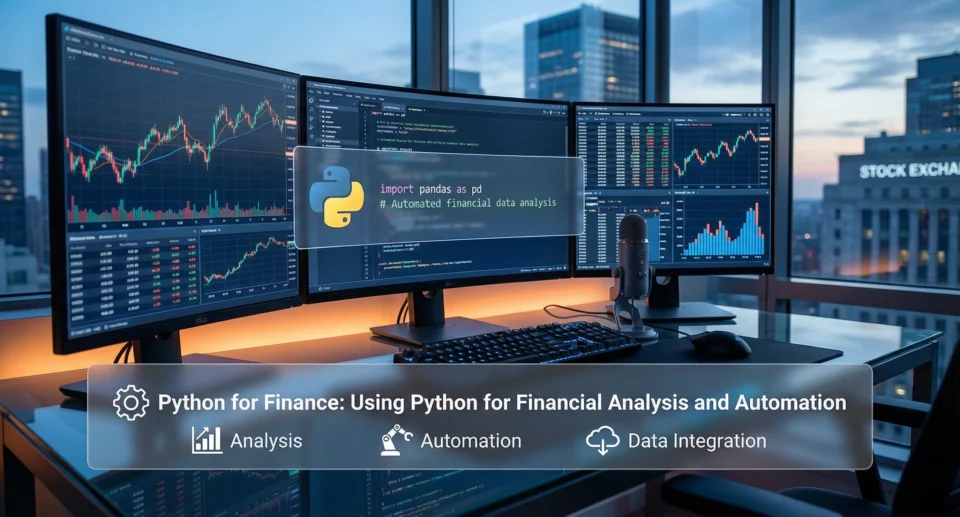
Table of Contents
Let’s get one thing out of the way.
Most finance professionals don’t learn Python because they suddenly fall in love with programming.
They learn it because they’re tired of doing the same manual work over and over.
Copying data.
Cleaning spreadsheets.
Running the same reports every month.
Python and Finance becomes interesting when it saves time.
A lot of time.
And once you experience that, it’s hard to go back.
This isn’t about becoming a software engineer.
It’s about giving yourself a smarter toolbox.
Why Python Fits So Well in Finance
Finance work lives in data.
Large tables.
Repeating calculations.
Consistent logic.
Python handles these things naturally.
It’s flexible.
It’s readable.
It has an enormous ecosystem of libraries built specifically for data work.
And maybe most importantly…
You can start small.
One script.
One task automated.
One win.
That’s how most people begin.
What You Actually Need to Learn (And What You Don’t)
You don’t need advanced computer science.
You don’t need to build complex applications.
You need:
- Basic Python syntax
- How to work with data tables
- How to run calculations
- How to save results
That’s enough to unlock real value.
Everything else can come later.
Getting Comfortable With Python Basics
Python reads a lot like plain English.
That’s part of its charm.
You’ll spend time learning:
- Variables
- Lists
- Dictionaries
- If statements
- Loops
These sound technical.
In practice, they’re just ways of telling the computer:
“Store this.”
“Repeat that.”
“If this happens, do this.”
Once you grasp that idea, the fear fades.
The Game-Changer: Pandas
If Python for finance had a centerpiece, it would be pandas.
Pandas lets you work with tables of data the way you work with spreadsheets.
But faster.
And at scale.
With pandas, you can:
- Load Excel files
- Filter rows
- Create new columns
- Group data
- Calculate totals and averages
All with a few lines of code.
The first time you replace a 20-step Excel process with 10 lines of Python, something clicks.
Reading Data From Common Sources
Most finance data lives in:
- Excel files
- CSV files
- Databases
Python handles all of them.
You can pull data directly into your script, manipulate it, and output clean results.
No copy-paste.
No broken formulas.
Just repeatable logic.
Cleaning Data Without Losing Your Mind
Messy data is universal.
Extra spaces.
Wrong formats.
Missing values.
Python gives you tools to:
- Strip spaces
- Convert text to numbers
- Replace blanks
- Standardize formats
It’s not glamorous work.
But once it’s scripted, you never have to do it manually again.
That’s freedom.
Basic Financial Calculations
Python doesn’t care whether you’re calculating:
- Revenue growth
- Profit margins
- Loan payments
- Discounted cash flows
It’s all just math.
You can write formulas that mirror what you’d normally build in Excel.
The difference?
They don’t break when rows shift.
They don’t get accidentally overwritten.
They run the same way every time.
Time Series Analysis Made Easier
Finance lives in time.
Monthly sales.
Daily prices.
Quarterly forecasts.
Python handles dates well.
You can:
- Sort by date
- Resample data (daily to monthly)
- Calculate moving averages
- Compare periods
Once you start working with time series in Python and Finance , large datasets feel much less intimidating.
Visualization: Seeing the Story
Numbers matter.
Pictures help.
Python can generate:
- Line charts
- Bar charts
- Histograms
You don’t need fancy visuals.
You need clear ones.
The goal is understanding, not decoration.
A simple trend line often beats a complicated dashboard.
Automation: Where Python Really Shines
Analysis is great.
Automation is life-changing.
With Python, you can automate tasks like:
- Downloading data
- Cleaning files
- Running calculations
- Generating reports
- Saving outputs
All on a schedule.
No more “end-of-month panic.”
You press a button.
Or better yet, nothing at all.
It just runs.
A Realistic Automation Example
Imagine this monthly routine:
- Download sales file
- Clean formatting
- Add calculations
- Create summary
- Save report
With Python, that becomes one script.
Next month?
Run script.
Done.
That’s not a dream scenario.
That’s normal Python usage.
Error Reduction Is an Underrated Benefit
Humans make mistakes.
Especially when tired.
Automation doesn’t get tired.
If your logic is correct, it runs the same way every time.
That consistency alone is worth learning Python for.
Working Alongside Excel (Not Replacing It)
Python doesn’t have to replace Excel.
They work well together.
Many professionals use Python to:
- Prepare and clean data
- Perform heavy calculations
- Export results to Excel
Then they use Excel for final formatting or quick checks.
You don’t have to choose sides.
Version Control (Lightly)
You don’t need advanced software tools.
But saving versions of your scripts matters.
Simple habit:
Keep dated copies.
Or use folders by project.
Future-you will appreciate it.
Learning Strategy That Actually Works
Don’t start with massive courses.
Start with a problem you already have.
Something annoying.
Something repetitive.
Google how to do that one thing in Python.
Build from there.
Momentum beats perfection.
Expect Frustration (It’s Normal)
Your code won’t work sometimes.
You’ll stare at errors.
Everyone does.
Even experienced developers.
The difference?
They keep going.
Treat errors as clues, not failures.
How Python Changes Your Role
Quietly.
You become the person who:
- Solves problems faster
- Handles larger datasets
- Builds repeatable solutions
That tends to lead to better projects.
More trust.
More interesting work.
Not overnight.
But steadily.
You Don’t Need to Be “Technical”
Many people avoid Python because they think they’re “not technical.”
That label doesn’t matter.
If you can build formulas in Excel, you can learn Python.
It’s the same logical thinking.
Just written differently.
A Small Truth
Most finance professionals don’t need to be elite programmers.
They need to be good enough to automate boring work.
That alone creates massive value.
Conclusion Description
Python gives finance professionals a practical way to analyze data faster, automate repetitive tasks, and build reliable workflows. You don’t need to become a programmer—just learn enough to turn everyday problems into simple scripts that save time and reduce errors.