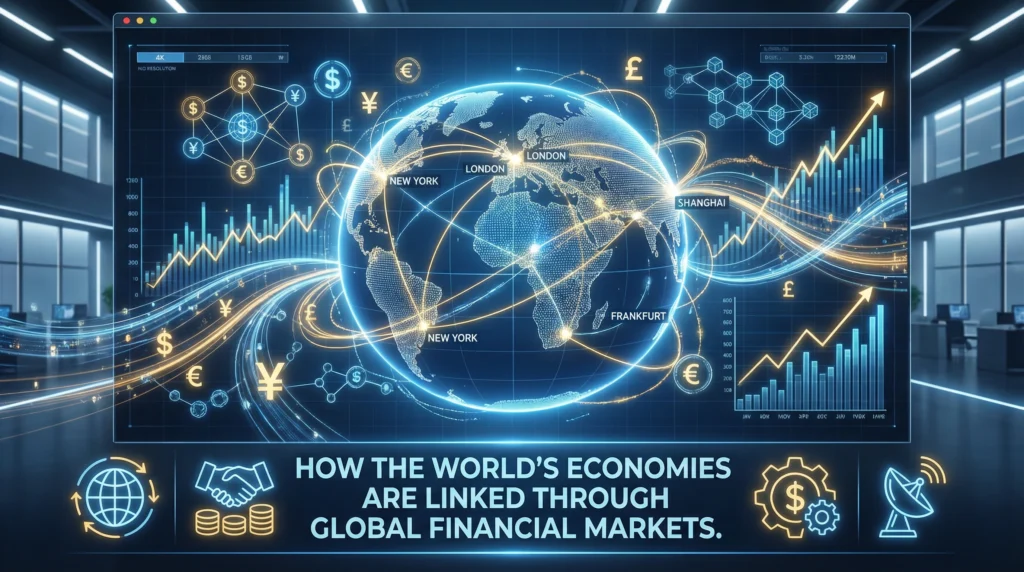
How the world’s economies are linked through global financial markets

Table of Contents
You might read about how markets in New York, London, Shanghai, or Dubai all reacted to the same thing when you read financial news. A drop in one U.S. stock can affect stocks in Asia by the next morning. Changes in currency, oil prices, and even political news suddenly seem very important around the world.
It can be hard to understand. But the truth is simple: the world’s financial markets are very connected to each other. Money moves quickly, and economies are always affecting each other. This network helps explain why markets seem to jump or fall without warning.
What We Mean by the World’s Financial Markets
In short, a financial market is a place where people trade money and investments. It could be a market for stocks, bonds, or goods. “Global” just means that these markets aren’t separate; they affect each other across borders.
Businesses, investors, banks, and governments all take part. Every choice, like a central bank raising rates or a big company releasing earnings, can send signals all over the world. And sometimes, those signals get stronger in ways that are surprising.
How economies affect one another
Picture the world’s economies as a web of pipes that are all connected. When one economy gets better, it puts pressure on other economies. The effects spread outward when one slows down.
For instance:
If China slows down, it could lower demand for raw materials, which would hurt exporters in Australia or Brazil.
When the U.S. raises interest rates, the dollar gets stronger, which makes it harder for emerging markets to pay off their debts.
When oil prices go up, countries that produce oil can benefit, but countries that buy oil can have problems.
Because of these ties, global investors are never just watching one economy; they’re watching dozens at once.
The main global markets and what they do
Some markets have more power than others. Here’s a quick look:
The U.S. stock market (NYSE, NASDAQ)
The U.S. stock market (NYSE, NASDAQ) is the biggest in the world. Trends here often affect how people feel around the world.
European markets
European markets are very affected by trade policies, interest rates, and politics in the region.
Asia (Tokyo, Shanghai, Hong Kong)
Asia (Tokyo, Shanghai, Hong Kong) is a major production and consumer centre, so changes here can have a big effect on other places.
Emerging Markets
Emerging Markets: Countries in Latin America, Africa, and Southeast Asia can be unstable, but they are becoming more and more connected to global investment flows.
There are different rules, hours, and tools for each market, but they all interact through capital flows, trade, and investor sentiment.
Currency Markets: The Heart of World Trade
The biggest financial markets in the world are the foreign exchange (FX) markets. Every day, trillions of dollars change hands as businesses pay for imports, investors move money, and central banks change their reserves.
Currencies can tell us how healthy the economy is. A strong currency can show that people have faith in it and bring in investment. A weak currency can help exports, but it can also raise prices in countries that rely on imports.
FX markets are also directly linked to trade around the world. For example, if the dollar goes up, it costs more to service debt in emerging markets that is denominated in dollars. This can cause markets to move far away from the U.S. Where Money Meets Resources
Where Money Meets Resources
Gold, oil, copper, and agricultural goods are more than just things you can buy; they are also financial tools. Prices of goods around the world have an impact on inflation, business profits, and government budgets.
Oil
Oil affects the costs of transportation, energy bills, and the profits of energy companies.
Gold
Gold is often thought of as a safe place to put money in times of uncertainty.
Copper and metals
Copper and metals are signs of industrial activity around the world.
These goods are traded all over the world, so problems with supply in one area can cause price shocks everywhere.
The Invisible Thread Between Bonds and Interest Rates
Governments and businesses can borrow money on the global bond markets. People all over the world buy these bonds to get safety, income, or a mix of both.
Interest rates in one country can affect the flow of money into another. For instance, when U.S. Treasury yields go up, money may move from emerging markets to safer U.S. assets. That’s why people all over the world pay attention to bond markets and central bank policies: changes rarely stay in one place.
Why do stock markets respond to news from around the world?
Stock markets today don’t just respond to news about local earnings or politics. They respond to signals from all over the world.
Examples:
Wars and trade disputes are examples of geopolitical events that can have an effect on supply chains and investor confidence.
When there are global pandemics or slowdowns in the economy, growth expectations change everywhere.
Big changes in policy in one area can affect currencies, bonds, and stocks all over the world.
Investors have learnt to pay attention to the “big picture” because even small pieces of news can cause big changes around the world.
How Investors Deal with Markets that Affect Each Other
It’s easy to feel overwhelmed by connections around the world, but most investors take a step back.
Diversification
Diversification means putting money into different regions, sectors, and types of assets to lower risk.
Watching key indicators
Watching key indicators like inflation, GDP growth, unemployment, and decisions made by central banks can help you understand global trends.
Understanding correlations
Understanding correlations: Knowing how markets move together or apart can help you make smart choices.
Knowing how things are connected around the world doesn’t guarantee success, but it does give you a better idea of what’s going on. And in today’s fast-paced markets, context is more important than ever.
The main point is that we’re all connected.
Global financial markets aren’t a secret; they’re a web of economies, investors, and institutions that all work together. Things that happen in one part of the world almost never stay there. When you know how these things are connected, markets don’t seem as random and more like a system you can read and respond to wisely.
When you stop thinking of global markets as separate from each other, sudden drops or spikes start to make more sense. It’s not just luck; there are reasons for everything.
Description of the Conclusion
The world’s financial markets are very connected, and changes in one region’s economy can have effects all over the world. People and professionals can better understand market changes and make investments with more confidence if they know how currency flows, commodity prices, bond markets, and investor behaviour work.