
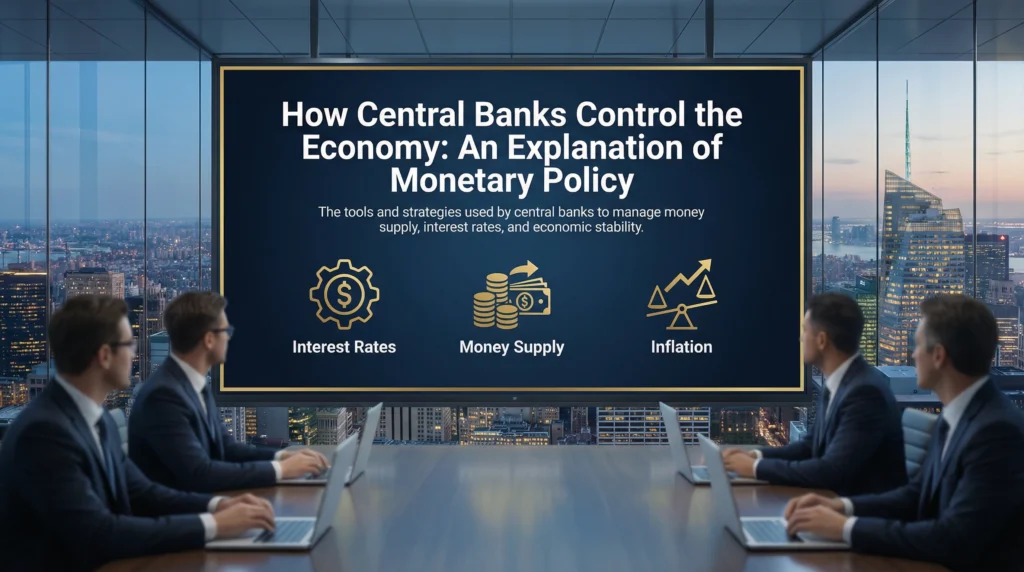
How Central Banks Control the Economy: An Explanation of Monetary Policy

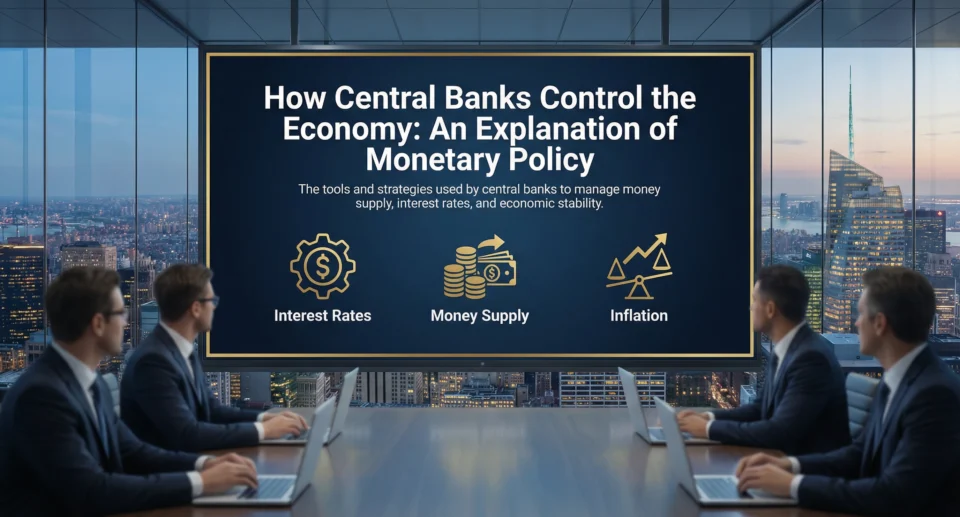
Table of Contents
We don’t usually think about central banks when we wake up. We think about things like grocery store prices, rent, petrol, job security and maybe whether now is a good time to get a loan. But behind all of that, monetary policy is doing a lot of the hard work.
It’s one of those things that changes everyday life without making a sound. Changes like rising inflation, rising loan costs, and savings accounts suddenly paying more interest are usually the result of decisions made by a central bank.
Let’s take a step back and talk about monetary policy in simple terms. No too much jargon. No textbook tone. How it works, why it matters, and how it gets to your wallet.
What Monetary Policy Really Means
Controlling money is the main goal of monetary policy. There are no secret levers behind closed doors or printing money all the time. Instead, the government just controls how much money moves through the economy and how much it costs to borrow.
Central banks use monetary policy to keep the economy from going crazy. Not too hot. Not too cold.
Prices go up too quickly when the economy gets too hot. That’s what inflation is. People lose their jobs, businesses stop investing, and growth stops when the economy slows down too much. Monetary policy tries to keep things in the middle.
It’s not easy to find that balance. And it’s never right.
What Central Banks Do and Why They Matter
There is a central bank in every country. The Federal Reserve is in charge of it in the U.S. The State Bank of Pakistan is in charge in Pakistan. The Bank of England is in the UK.
It’s not their job to make money. To keep the economy stable.
Three main goals are what most central banks work towards:
- Keeping prices from going up too fast
- Helping the economy and jobs grow
- Keeping the financial system stable
They don’t have direct control over the economy. They have an effect on it by pushing behaviour instead of ordering it.
And the main way they do that is by changing interest rates.
Interest rates are the main thing that controls things.
Interest rates would be the steering wheel for monetary policy.
Interest rates tell you how much it costs to borrow money. It feels easier to borrow money when rates are low. As rates go up, loans get harder to pay back.
Take a moment to think about it.
Usually, lower interest rates mean:
- Loans for businesses that cost less
- Financing a home is easier
- More money spent and invested
Most of the time, higher interest rates mean:
- Loans that cost a lot
- Spending less quickly
- Less borrowing and more saving
Central banks change rates based on what the economy needs at the time.
Tight versus Loose Monetary Policy
There are usually two main directions that monetary policy goes in.
Loose monetary policy that encourages growth
This happens when the economy is weak or not growing as fast as it should.
To get people to borrow and spend more, central banks lower interest rates. More money goes into businesses. People spend more. Business is getting better.
A lot of people do this when the economy is bad or in a recession.
But there’s a problem. Inflation can go up over time if there is too much easy money.
Tight monetary policy
This kicks in when inflation gets out of hand.
To cool things down, central banks raise interest rates. People stop borrowing. Spending goes down. Prices settle down—eventually.
People don’t like it. Higher rates are bad for borrowers. Slower growth. But it’s often necessary to stop damage from getting worse.
How Central Banks Really Change Interest Rates
Central banks don’t go into banks and tell them what to charge you. Instead, they have an effect on short-term rates that spread through the system.
They do this mostly by setting a policy rate, which is the standard interest rate for banks to lend to each other.
When that rate goes up or down:
- Commercial banks change the rates at which they lend money
- The costs of loans change
- Changes in how people act
It’s not direct, but it’s strong.
The Quiet Mechanism: Open Market Operations
Another thing that central banks do is buy and sell government bonds.
When a central bank buys bonds, it puts money into the economy. Banks have more money to lend. Interest rates usually go down.
When it sells bonds, it takes money out. Lending gets harder. Rates go up.
Most people never see this happen. But it quietly changes liquidity behind the scenes.
Reserve Requirements: Not as Common, but Still Important
Banks don’t give out all the money they get. They have to keep some of it in reserve.
This requirement can be changed by central banks.
- More lending happens when reserve requirements are lower.
- Less lending when reserve requirements go up
This tool is very powerful, so it is only used when necessary. Little things can have big effects.
Inflation: The Big Issue That Central Banks Keep an Eye On
Prices going up isn’t the only thing that causes inflation. It’s how quickly prices go up.
A little bit of inflation is normal, and even good. It makes people want to spend and invest.
But when inflation rises too quickly, it makes it harder to buy things. Salaries don’t keep up. Money you save loses value. More and more uncertainty.
That’s why central banks respond strongly to signs of inflation. Sometimes even in a rude way.
You may have seen this happen in the last few years. Fast rate increases. Hard choices. Pain for a short time to get things back on track.
Monetary Policy and Fiscal Policy (They’re Not the Same)
A lot of people get these two mixed up.
Central banks are in charge of monetary policy.
Governments are in charge of fiscal policy.
Fiscal policy includes:
- Taxes
- Money spent by the government
- Deficits in the budget
Monetary policy is all about the amount of money in circulation and interest rates.
They affect each other, but they are run by different groups, which often have different goals.
How monetary policy affects daily life
This is where things start to happen.
It shows up everywhere when interest rates go up or down:
- Loan EMIs go up or down
- Payments on mortgages change
- Credit cards cost more
- Savings accounts make more or less money.
- Job markets get tighter or looser.
Even if you don’t pay attention to the news about the economy, you still hear about monetary policy all the time.
Why do decisions made by the central bank sometimes seem “wrong”?
You might be asking, “Why raise rates when people are already having a hard time?”
Because central banks think about the long term. They aren’t just reacting to the pain of today. They want to stop bigger problems from happening in the future.
That doesn’t make making decisions easy. It just makes sense.
And yes, they do get it wrong sometimes. Physics isn’t economics. It’s messy, human, and hard to predict.
Is Monetary Policy the Answer to Everything?
No. And it shouldn’t.
Monetary policy can’t fix problems with supply. It can’t fix problems with politics. It can’t make productivity grow by itself.
It is not a miracle cure; it is a stabiliser.
That’s why it’s so important to coordinate fiscal policy with structural reforms.
The Lag Effect: Why It Takes Time to See Results
Timing is one of the most misunderstood parts of monetary policy.
It could take months or even a year for the full effect of a central bank raising interest rates to be felt.
It takes time to make borrowing decisions. It takes time to make business investments. It takes time to change prices.
That delay makes it hard to make decisions. Most of the time, decisions are based on predictions, not facts.
Developing economies have to make tougher choices.
For developing countries, it can be hard to make good monetary policy.
They often deal with:
- Pressure on currency
- Debt from outside
- Inflation from imports
- Risks of capital flight
Raising rates could make the currency more stable, but it could also slow growth. Lowering rates might help the economy grow, but it could also hurt exchange rates.
It’s not often easy to choose.
Why it’s important for the central bank to be independent
Most countries try to keep politics out of their central banks.
Why? Because political pressure often puts short-term comfort ahead of long-term stability.
When they need to, independent central banks can make unpopular choices, like raising rates before inflation gets out of hand.
That independence gives you more credibility. And credibility makes policy work better.
Final Thoughts: Why You Should Pay Attention to Monetary Policy
You don’t have to be an economist to understand how money works. You just need to look at it for what it is: a set of tools that help the economy run smoothly.
It’s not perfect. It doesn’t always feel good. But it’s necessary.
When interest rates change or inflation makes the news, you’ll know that something else is going on besides just a number change. It’s a balancing act that happens quietly but has real effects on daily life.
Description of the Conclusion
One of the most important things that affects modern economies is monetary policy. Central banks affect inflation, growth, and financial stability by controlling interest rates and the amount of money in circulation. People often feel these effects long before they understand them. Understanding how it works helps you understand changes in the economy that affect your daily life.