
Stock Market Structure Explained: The Powerful Blueprint Behind How Financial Markets Really Work

Table of Contents

If you’ve ever bought a stock—or even just thought about it—you’ve probably wondered what actually happens behind the scenes. Where does your order go? Who’s on the other side of that trade? And how does it all work without turning into chaos?
The stock market might look like a single place on your phone screen, but in reality, it’s more like a well-coordinated system of moving parts. Quietly complex, surprisingly logical, and built to keep things running smoothly even when millions of trades happen at once.
Let’s slow it down and make sense of it, without the jargon overload.
What the Stock Market Really Is (And What It Isn’t)
The stock market isn’t one building or one company pulling strings. It’s a network.
At its core, it exists for one simple reason:
to connect people who want to buy investments with people who want to sell them.
That’s it.
Companies come to the Stock Marketto raise money. Investors show up looking for growth, income, or both. The structure of the market is what makes those connections fair, transparent, and—most of the time—efficient.
Without structure, prices would be unreliable, trades would be slow, and trust would disappear fast.
Primary Market vs. Secondary Market (Where It All Starts)
This is one of those concepts that sounds technical but is actually pretty intuitive.
The Primary Market
This is where stocks are born.
When a company goes public for the first time through an IPO, it’s selling shares directly to investors. The money raised goes to the company itself. Think of it as the company saying, “We’re opening ownership to the public.”
Once those shares are sold, the company steps back.
The Secondary Market
This is where most people spend their time.
Here, investors trade shares with each other. The company doesn’t get paid again when you buy a stock—it already raised its capital earlier. What you’re buying is ownership from another investor.
Stock exchanges live in this secondary market.
Stock Market Exchanges: The Organized Trading Floors
A stock exchange is a regulated marketplace where securities are bought and sold under specific rules.
You’ve probably heard the big names:
- New York Stock Market Exchange (NYSE)
- NASDAQ
- London Stock Market Exchange
- Pakistan Stock Market Exchange (PSX)
Each exchange has its own listing requirements, trading systems, and oversight, but the goal is always the same:
fair price discovery and orderly trading.
Some exchanges started as loud physical trading floors. Others were digital from day one. Today, almost everything happens electronically, even if the old images still stick in our minds.
Over-the-Counter (OTC) Markets: Less Formal, Still Important
Not all stocks trade on major exchanges.
OTC markets handle securities that don’t meet exchange listing requirements or choose not to list. Trades happen through dealer networks instead of a centralized exchange.
This space includes:
- Smaller companies
- Foreign securities
- Certain bonds and derivatives
OTC markets can offer opportunity, but they also come with less transparency and higher risk. That’s why regulation and investor awareness matter more here.
Market Participants: Who’s Actually Involved?
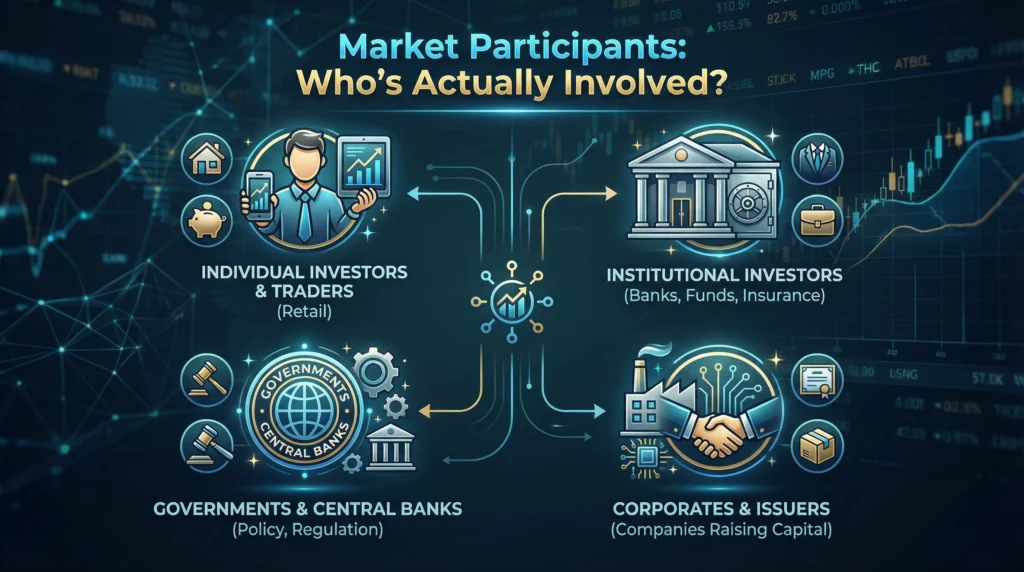
The market isn’t just buyers and sellers clicking buttons. There’s a whole ecosystem at work.
Retail Investors
That’s regular people—individuals investing their own money. They’re a smaller piece of the volume, but collectively, they matter more than ever.
Institutional Investors
Think mutual funds, pension funds, hedge funds, insurance companies. These players move large amounts of capital and often shape market trends.
Brokers
Brokers act as the bridge between investors and the market. When you place a trade, your broker routes it to the appropriate marketplace.
Market Makers
These are firms that provide liquidity by constantly offering to buy and sell specific securities. Their presence helps keep spreads tight and trading smooth, even during volatile moments.
Without them, price gaps would be wider, and trades would take longer to execute.
How Orders Actually Get Matched
When you place an order, you’re not just throwing it into the void.
Orders are matched using order books that list:
- Buy orders (bids)
- Sell orders (asks)
The system prioritizes:
- Best price
- Then speed (who came first)
If your buy price matches someone else’s sell price, the trade happens. Simple on the surface, deeply engineered underneath.
And yes, this happens in fractions of a second.
Regulation: The Quiet Backbone of the Market
Markets don’t regulate themselves very well. History made that clear.
That’s why regulatory bodies exist—to enforce rules, prevent manipulation, and protect investors. Each country has its own watchdogs, setting standards for disclosure, reporting, and trading behavior.
Regulation doesn’t eliminate risk.
It just makes sure the game isn’t rigged.

Different Market Segments You’ll Hear About
You’ll often see markets described in different ways. It helps to know what people mean.
- Equity Market – Stocks and ownership
- Bond Market – Debt and fixed income
- Derivatives Market – Futures, options, and contracts based on underlying assets
- Money Market – Short-term, low-risk instruments
Each serves a different purpose, but together they keep capital flowing through the economy.
Why Market Structure Actually Matters to You
It’s easy to think market structure is just background noise. But it directly affects:
- How quickly your trades execute
- How fair your prices are
- How much transparency you get
- How protected you are as an investor
When markets are well-structured, confidence grows. When they aren’t, even good investments can turn stressful fast.
Understanding the structure doesn’t make you immune to losses—but it does make you a calmer, more informed participant.
And that counts.
The Big Picture
The stock market isn’t magic. It’s not random, either.
It’s a carefully organized system built to move money, share ownership, and balance risk between millions of participants who’ll never meet each other. Once you understand how it’s put together, the headlines feel less intimidating, and the daily ups and downs make a bit more sense.
You don’t need to master every detail.
Just knowing how the pieces fit together puts you ahead of most people already.
Conclusion Description
Understanding stock market structure helps investors see beyond price movements and headlines. When you know how markets are organized, who participates, and how trades flow, investing feels less mysterious and more manageable. It’s not about complexity—it’s about clarity.

