
Investment Risk Analysis: Identifying and Managing Financial Risk

Table of Contents
Investment Risk Analysis
If you’ve ever thought about investing—even casually—you’ve probably felt that little knot of uncertainty in your stomach. What if the market drops? What if this company doesn’t perform the way you expect? That feeling isn’t a bad thing. It’s actually your instincts brushing up against something real: risk.
Investment risk analysis is basically the process of understanding what could go wrong before you put your money on the line. Not to scare yourself out of investing, but to make smarter, calmer decisions when things don’t go exactly as planned. And trust me, they rarely do.
Let’s break this down in a way that feels human, practical, and usable in real life—not like a finance textbook.
What investment risk really means
At its core, risk is uncertainty. You’re committing money today with the hope that it’ll be worth more tomorrow, next year, or ten years down the road. But the future doesn’t come with guarantees.
Risk doesn’t always mean “loss,” though. Sometimes it just means returns that are lower than expected. Other times, it means volatility—prices jumping up and down in ways that test your patience. And yes, occasionally it does mean losing money.
The key thing to understand is this: you can’t eliminate risk entirely, but you can understand it, measure it, and manage it.
The main types of investment risk (without the jargon overload)
Not all risks are created equal. Some are obvious, others sneak up on you later. Here are the most common ones investors deal with.
Market risk
This is the big, unavoidable one. When the overall market drops due to economic slowdowns, political uncertainty, or global events, most investments feel the impact. Even strong companies can see their stock prices fall during rough periods.
You didn’t do anything wrong—it’s just the market doing what markets do.
Company-specific risk
This one is more personal. It’s tied to how a specific company is run. Poor management decisions, declining sales, legal trouble, or failed products can all hurt performance.
You might believe in a company, but things can still go sideways. It happens.
Interest rate risk
This mainly affects bonds and fixed-income investments. When interest rates rise, existing bonds often lose value. When rates fall, they tend to look more attractive.
It’s one of those quiet risks people don’t think about until it shows up.
Inflation risk
Inflation slowly eats away at your purchasing power. If your investment returns don’t beat inflation, you’re technically losing money—even if the numbers look positive on paper.
It’s subtle, but over time, it matters a lot.
Liquidity risk
Some investments are hard to sell quickly without taking a hit on price. Real estate, private equity, or thinly traded assets fall into this category.
If you suddenly need cash, liquidity risk can become very real, very fast.
Why risk analysis matters more than chasing returns
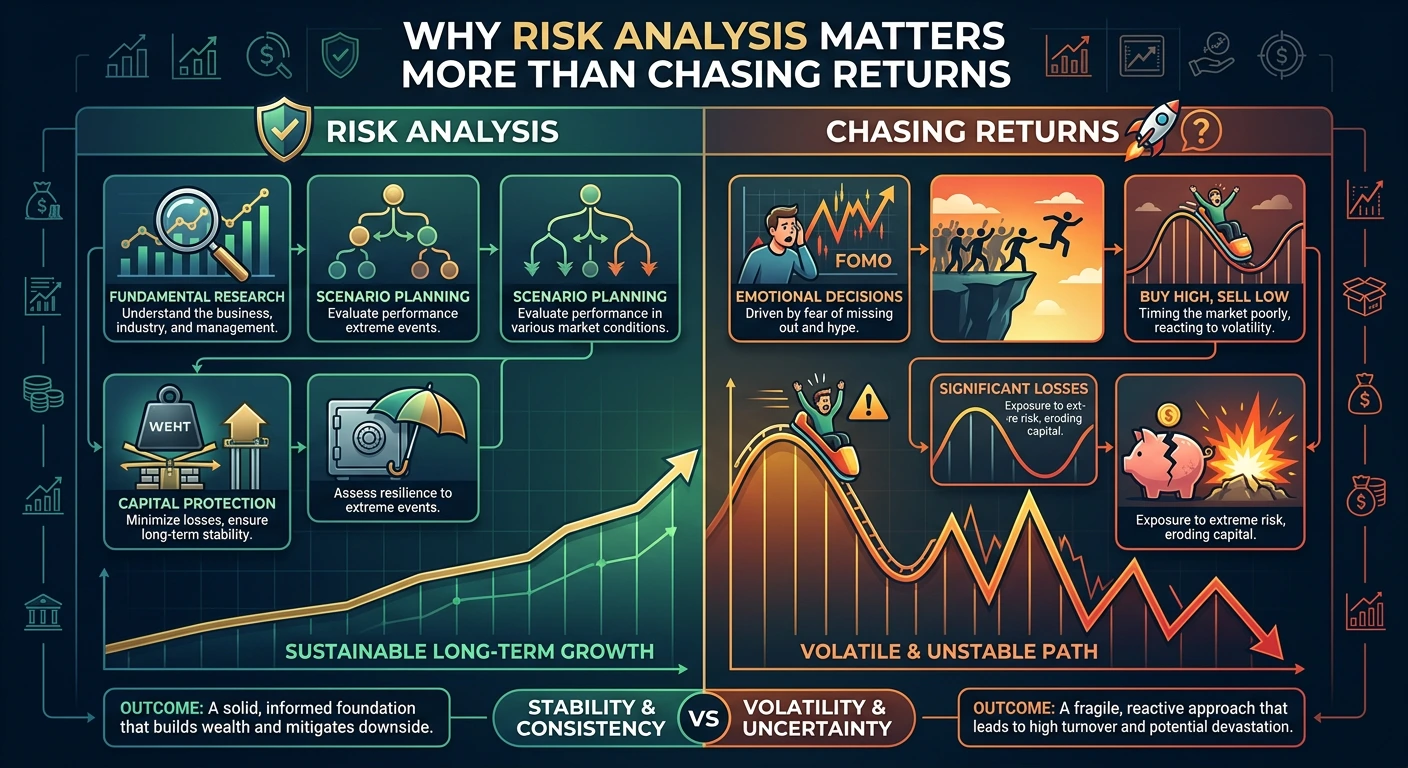
It’s tempting to focus only on potential gains. Big returns sound exciting. They make great stories. But high returns almost always come with higher risk.
Risk analysis helps you answer questions like:
- How much could I realistically lose?
- Can I handle that loss emotionally and financially?
- What happens if this investment doesn’t work out?
These questions aren’t pessimistic. They’re responsible.
Good investors don’t just ask, “How much can I make?”
They also ask, “What’s my downside, and am I okay with it?”
Understanding your own risk tolerance (this part is personal)
Two people can look at the same investment and feel completely different about it. One sees opportunity. The other sees stress.
That’s risk tolerance.
Your risk tolerance depends on a few things:
- Your age
- Your income stability
- Your financial goals
- Your experience with investing
- And honestly… your personality
If market drops make you lose sleep, you probably need a more conservative approach. If you can handle short-term losses without panicking, you may be comfortable taking on more risk.
There’s no “correct” level of risk. There’s only what fits you.
How investors analyze risk in real life
Risk analysis doesn’t have to be complicated or overly technical. Here’s how it usually looks in practice.
Looking at historical performance (with context)
Past performance isn’t a promise, but it does give clues. How has this investment behaved during market downturns? Did it recover? How volatile was it?
You’re not just looking for growth—you’re looking for resilience.
Understanding volatility
Volatility measures how much prices move up and down. High volatility can mean bigger gains, but also sharper drops.
If something swings wildly every few weeks, ask yourself if you’re prepared for that ride.
Evaluating fundamentals
For stocks, this means looking at things like earnings, debt levels, cash flow, and business model strength. Strong fundamentals don’t remove risk, but they can reduce unpleasant surprises.
Think of it as checking the foundation before buying a house.
Stress-testing scenarios
Smart investors ask “what if?” questions:
- What if interest rates rise?
- What if the economy slows down?
- What if this sector falls out of favor?
You don’t need perfect answers. You just need awareness.
Managing risk instead of fearing it
Risk isn’t the enemy. Poor risk management is.
Here are some practical ways investors manage risk without overthinking it.
Diversification
You’ve probably heard “don’t put all your eggs in one basket.” It’s common advice because it works.
Spreading investments across different assets, industries, and regions helps reduce the impact of any single failure. One investment struggling won’t sink the entire portfolio.
It’s not flashy—but it’s effective.
Asset allocation
This is about balance. Stocks, bonds, cash, real assets—each behaves differently. The mix you choose should reflect your goals and risk tolerance.
More aggressive portfolios lean toward growth assets. Conservative ones prioritize stability.
Neither is better. They’re just different tools for different needs.
Position sizing
Even a good investment can become dangerous if it’s too large a portion of your portfolio. Limiting how much you invest in any single asset keeps mistakes from becoming disasters.
This one small habit saves a lot of regret.
Regular reviews (not constant panic-checking)
Markets change. Life changes. Your portfolio should evolve too.
Reviewing investments periodically helps ensure they still align with your goals. Just don’t confuse reviewing with reacting emotionally to every headline.
There’s a difference.

The emotional side of risk (often ignored, always important)
Numbers matter. But emotions matter just as much.
Fear and greed push people to buy at the top and sell at the bottom. Risk analysis helps you stay grounded when emotions run high.
When you understand why you own an investment and what risks you accepted upfront, you’re less likely to make impulsive decisions during market turbulence.
Calm isn’t accidental. It’s planned.
Risk changes over time—and that’s normal
A young investor saving for long-term growth can usually afford more risk. Someone nearing retirement often can’t.
As your life changes, your approach to risk should change too. That’s not weakness. That’s maturity.
Adjusting risk exposure over time is part of responsible investing, not a sign that something went wrong.
Final thoughts
Investment risk analysis isn’t about predicting the future or avoiding every loss. It’s about understanding what you’re getting into and choosing risks that make sense for your situation.
When you take the time to identify and manage financial risk, investing feels less like gambling and more like decision-making. You stop reacting and start responding.
And honestly, that confidence—quiet, informed confidence—is one of the most valuable returns investing can give you.


